Best Bass Lures for June: Top Picks for Post-Spawn Bass

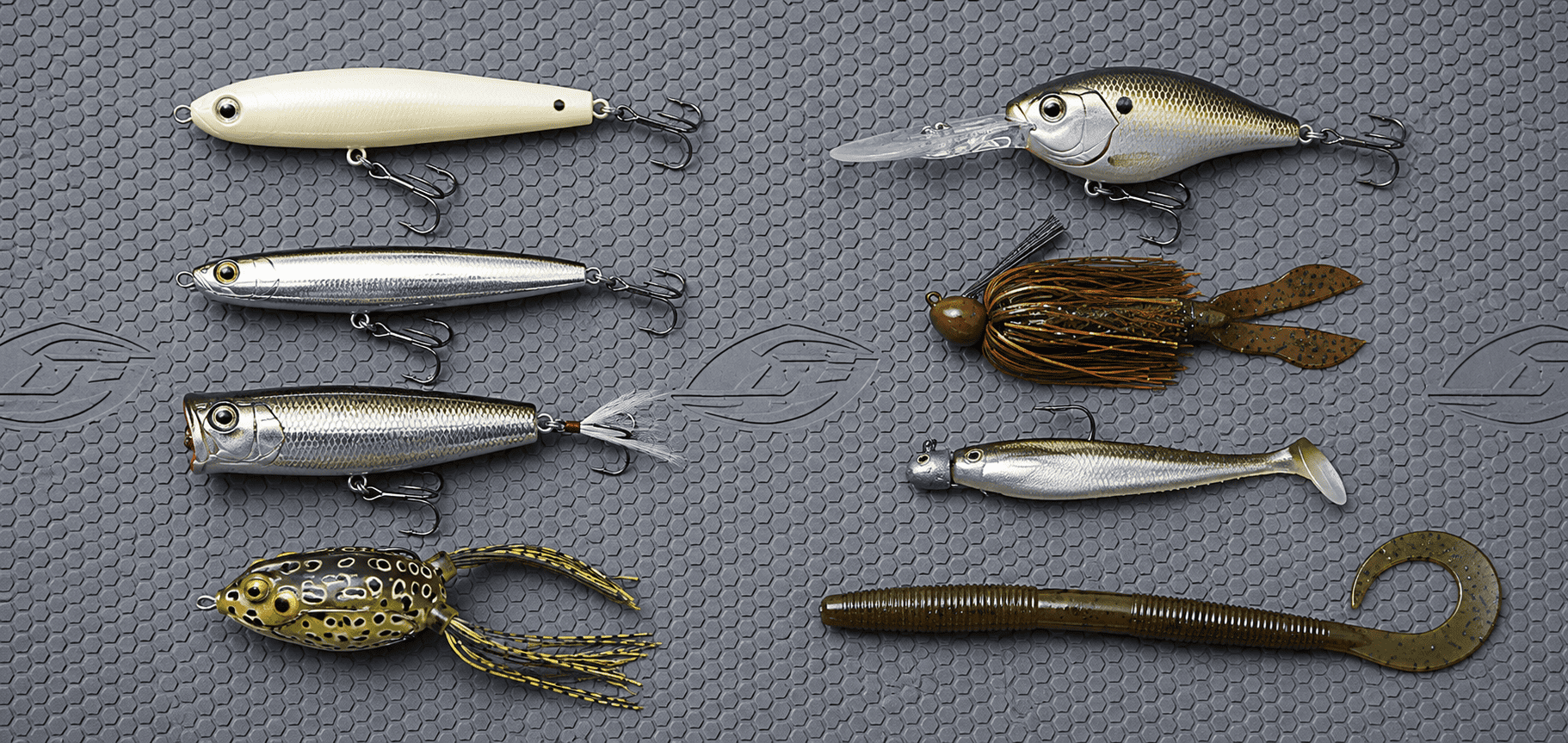
June marks the spot in the calendar year when summer is officially here. With water temperatures pushing past 75 degrees towards the 80-degree mark, most of the bass spawn is over for the southern half of the country. The northern edge of the U.S. still has some spawning smallmouth to look forward to, but for most states, “post-spawn” is the word.
Post-spawn means more than the bass are done spawning. Post-spawn is a change in bass demeanor from spawning, defending, and protecting to “Let’s go eat!”
Filling their bellies is now the primary objective.
Post-Spawn Bass Behavior
To put on the feed bag, bass usually start with the shad or herring spawns in May. Depending on the lake, bass might be more prone to raiding bluegills for dinner. But once the forage spawns wind down, bass begin to move out to where their forage is more easily available. That means moving out closer to the main flow of a lake to find schools of shad or herring feeding in more fertile currents on the main drag. In lakes with ample current flow, primary river channel ledges become prime real estate where the megaschools are growing.
In highland impoundments with very little flow, bass begin roaming over deep primary points in the bays and main lake. By early June, the water has not stratified enough to form hard thermoclines so shad schools can go deep, into the 20- and 30-foot range.
With water temperatures continuing to rise in the summer, bass metabolism goes up and they are eyeing large forage to fill their gullet. With all that in mind, the common lure themes in many lakes in June include moving out, going deeper, and presenting large profiles.
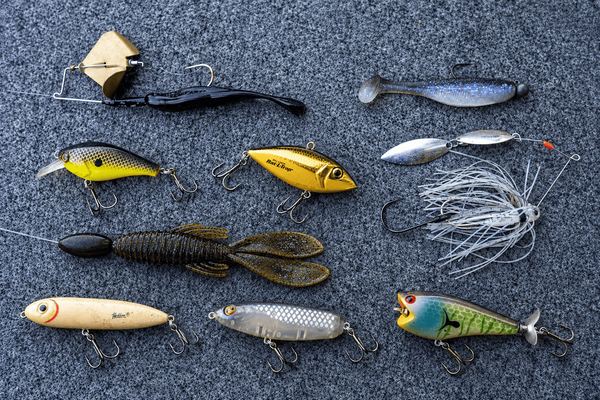
Topwater Baits
But before we go all in offshore, it’s worth noting that June is still a fantastic topwater month. After years of covering tournaments in the high-end electronics era, a key takeaway has been how many pros continue to catch good fish on topwaters well into June. even when water temperatures are past 80 degrees. Generally, it’s the morning window, but if clouds and wind are present, it can be extended until 10 or 11 a.m. Shade is a huge player in June topwater action as well.
Which topwater to use is dependent on the lake.
- A spook-type walking bait is hard to beat on shad-based highland impoundments.
- Herring bass are all about long, thin pencil poppers.
- Lowland impoundments featuring shallow cover such as bushes, docks, and willow grass are better suited for topwater poppers and prop baits.
- Natural lakes and reservoirs with heavy vegetation call for more critter-type topwaters like frogs and buzzing toads in scattered grass and pads.
Soft-Plastic Minnows
When the offshore game gets going, there is no denying that electronics in the form of sidescan and forward-facing sonar become extremely potent tools. Shaking a minnow in the beam is a tactic that is unequivocally hard to beat. Love it or hate it, the fact is, beaming a minnow is the most efficient way to pinpoint offshore bass schools. And nothing imitates the forage better than a soft-plastic shad on a lead-head. The ability to scale minnow size, action, color, and depth on the fly is equally as deadly. Quickly switching to a large 7- or 8-inch minnow is the trick that fools bigger post-spawn fish.
Deep Diving Crankbaits
While a minnow has risen to the top of the post-spawn lure list, the traditional lures still work, especially if bass suck down on the bottom, out of the beam’s view. This is when the traditional big deep-diving plugs designed to descend quickly and dredge depths of 15 to 20 feet can do some work.
Classics such:
- Strike King 6XD and 10XD
- Rapala DT20
- Norman DD-22 are dredging staples.
Other 20-plus options include
- Bill Lewis DR24
- Bassmooch Z Boss 25
- 6th Sense Crush 500DD
Standard Tennessee shad, sexy shad, and chartreuse shad colors work great when the schools first get deep.
Football Jigs
Along with dredging crankbaits, dragging big jigs is another effective June tactic. Big, bulky football jigs in the 1/2- to 1-ounce size are great for snooping out bass hiding down in rock, rubble, or pot holes on the bottom.
Over the years, sidescan has revealed just how late (and deep) bream will spawn. It’s not unheard of to find large, active bream beds in 10- to 15-feet of water all the way through June – the perfect situation for a football jig.
Bottom contact is essential with football jigs.
- ½- to ¾-ounce size is great for dragging river ledges, hard spots, shell bars, and island heads in 10 to 20 feet.
- If you need to go 20 feet plus on deep impoundments, better hunt up a 1-ounce version to keep bottom contact.
Options for football jigs run rampant with more than 50 lure brands making them. For June dragging, thicker skirts, or “mop skirts,” help present a bigger profile. As for colors, browns, blues, pumpkins, with maybe a little orange or purple for flair are good choices. Bulk it up with some type of double-appendage flapping trailer – and let the dragging begin.
Big Worms
Big 8- to 10-inch worms have been catching big bass for decades, and they’re still a perennial producer, especially when the offshore bite gets hot in June.
Basically, big worms come in two varieties:
Straight-Tail Worms
- Zoom Mag Trick Worm
- Maxscent Wag Worm
- Strike King Bull Worm
- Yamamoto Oki
Ribbon-Tail Worms
- Zoom Ol’ Monster
- Mag Ol’ Monster
- Berkley 10” or 12” Power Worm
- NetBait C-Mac 11
- 6th Sense Boosa 9.6
Either variety can be rigged on a standard Texas rig with a ¼- to ½-ounce weight or with a magnum shaky head in a 3/8- or ½-ounce size.
Rigging the large straight-tail worms on an oversized shaky head works well on bare ledges in current like those found in TVA lakes. They are also good for a fast fall and quick bottom contact on highland impoundments.
Big ribbon tails can also be pitched on heavy shaky heads in deep bank cover, like laydowns and docks.
Texas-rigging big worms is best done on grass lakes, especially in June when the grass is still sparse and clumpy.
Summer is here, and June is a classic case of starting at the top with topwaters, then going straight to the bottom with the dredgers and draggers for the offshore schools.