Bass Fishing After the Rain: How Storms Fire Up the Bite

It’s that time of year: the dog days of summer. This is when you might become a tad bit envious of those who live in the Northeast and the upper Midwest. Bass in their part of the country are perfectly comfortable in 65- to 75-degree water, eating everything in sight. Meanwhile, bass in the South are sweating profusely underwater with water temperatures pushing towards the 90s. The weather is hot; the fishing is not.
We all know the excuses that come with southern sizzling summers: warm water, stagnation, lethargic bass, scattered baitfish, thermoclines, low oxygen, bass roaming out in the middle of nowhere.
Most of those variables are legitimate. The peak of summer in the South takes its toll, and sometimes you have to look to the heavens and pray – for rain.
How Rain and Thunderstorms Trigger Bass Bites
Here’s the good news: with the heat and humidity of summer comes thunderstorms, and those afternoon and evening boomers can be a boon. To be clear: this is not a recommendation to fish in such weather. Plus, a short thundershower or two probably won't do much to help the cause. However, during July and August when weather patterns stagnate, large thunderstorms can form over the same geographic regions of the south for several days in a row. Whenever an extended period of extremely hot, stagnant conditions is suddenly interrupted by a deluge, it creates a unique bass fishing opportunity. Rain accumulations that reach 2 to 4 inches over a couple of days can send a perfect surge of fresh water down a system to perk bass up again. Obviously, true flood conditions from excessive rain need to be avoided. A few inches is one thing; 10 inches can be a real problem.
To best take advantage of thunderstorm accumulation, it’s important to find smaller lakes that sit in a topographic drainage basin. To be the beneficiary of a big rain doesn’t mean it needs to fall directly on the lake. It can downpour a couple of hours away and still bring fresh flow down the valley a day later.
This is especially true if you live in a region that features a primary drainage basin that hosts a chain of lakes. A couple of inches of rain in the main Tennessee River Valley might not do much for lakes as big as Chickamauga, Guntersville or Wheeler. But there are plenty of smaller basins, with smaller lakes, that are renewed with a couple of days of rain upstream. Smaller lakes in the 5,000- to 25,000-acre range are affected faster by a quick rain shed than massive 50,000-acre-plus lakes.
When rain creates a pulse of fresh, cool water through a lake, or chain of lakes, it provides a kind of reset. For starters, current generation usually increases. Sometimes this additional generation occurs before the rain even falls as lake managers pull the lake down a bit to prepare for incoming water.
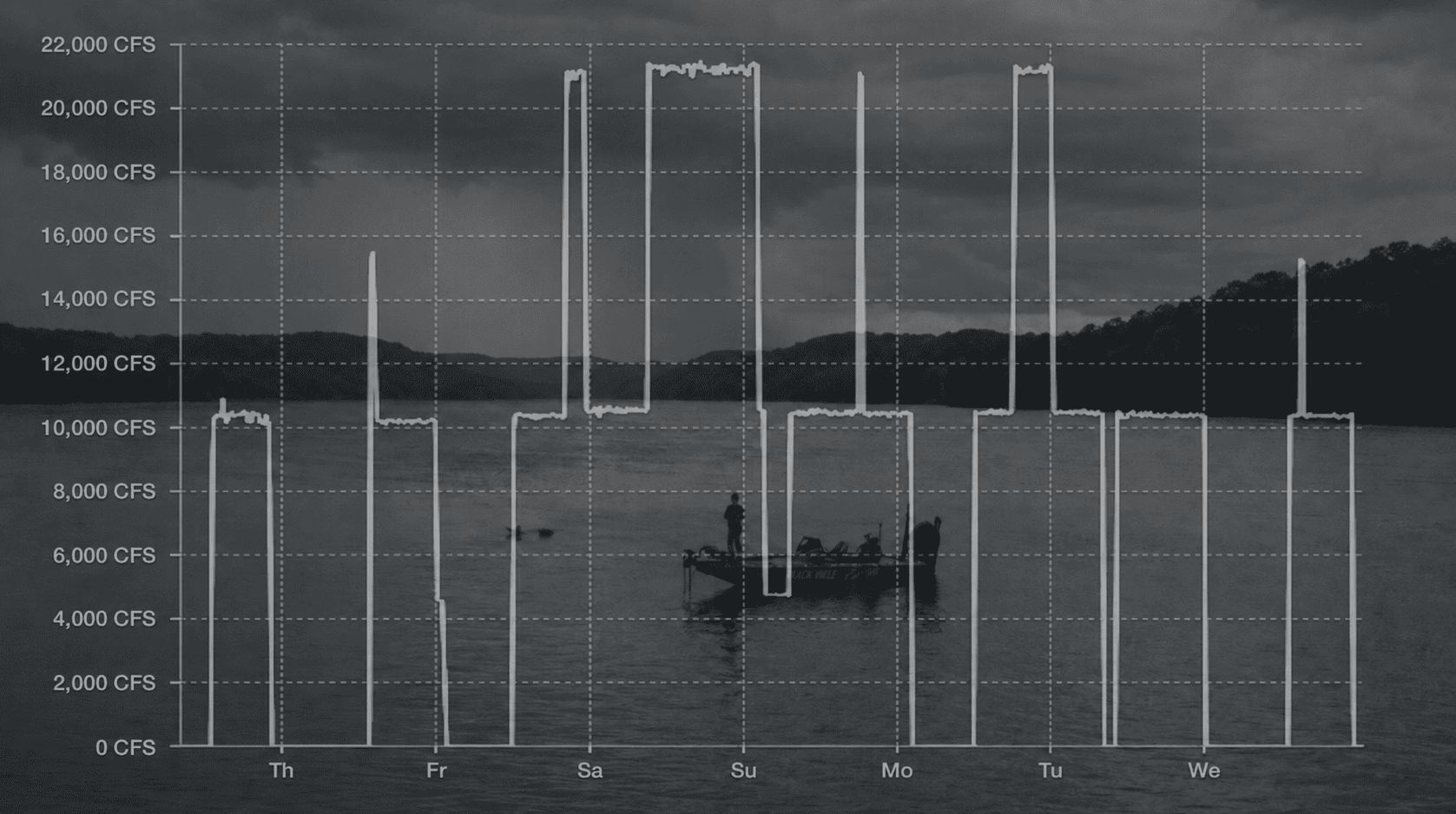
As the rainfall gathers in the basin and fills the primary river, an influx of cooler, oxygenated, nutrient-rich water pushes down the system into the lakes, breaking up stagnation with increased current. Dams that might normally run 5,000 to 10,000 CFS a few hours per day double the outflow volume for longer periods to move the water out. With that, shad begin to bunch back up to take advantage of the fresh flow. Bass are conditioned to cash in on these easy meals by returning to ambush locations near structure and cover.
How to Track the Surge With Deep Dive
When this process starts, the best way to keep up with the whole slug of water coming down a basin is with Deep Dive’s set of current-related tools.
- First, check to see how the water level is changing. Is there a sudden water level drop before the rain? That’s a sign they are anticipating a pulse.
- Then check the Outflow History graph to see if current generations in lakes above have increased. If the lakes have the Generation Releases feature, see how long the generators are scheduled to run.
- Finally, keep a close eye on the Streamflow maps for increased currents in the form of yellow and orange blinking arrows. The Streamflow tool, in particular, can be used to track the entire push of water flowing through the system. This helps show where the “wave” of water is and predicts when it will be reaching the lower lakes.
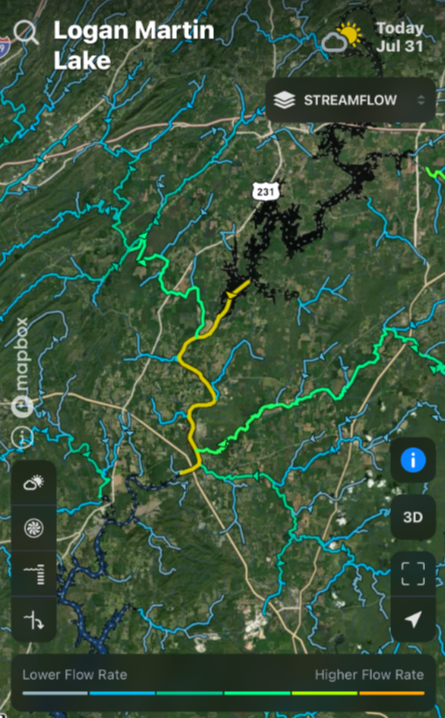
This process happens in drainage basins and chains of lakes all across the country as rainfall sheds from higher elevations. To find these basins, open the main map on Deep Dive, which shows lake locations. Scroll around until you find a series of lakes in a row.
Top River Chains to Target in the Southeast
One of the best examples of such a basin in the South is the Coosa River chain of lakes in Alabama, which includes lakes Weiss, Neely Henry, Logan Martin, Lay, Mitchell, and Jordan. During periods of little rain in the summer, generation is limited to a certain amount of power production per day. But if thunderstorms park over northeast Alabama and northwestern Georgia for a couple of days, the whole system cranks up to get the water moving, creating amplified current flow and better fishing conditions, making the bass frisky again.
Other examples of these scenarios exist throughout the Southeast.
Next door to the Coosa chain of lakes is the Tallapoosa chain, which includes Wedowee (Harris), Martin, Yates and Thurlow. Martin is the largest and least affected by water flow, but the other three are game for fresh pulses flowing through.
Some sneaky power ponds in Georgia include a trio of lakes along the Chattahoochee River between West Point and Eufaula: Lake Harding (Bartlett’s Ferry), Goat Rock and Oliver.
South Carolina gems Jocassee and Keowee, located above Lake Hartwell, get refreshed by summer showers as well. Two Catawba River lakes, Wylie and Wateree, are also smaller run-of-river lakes.
Due to the mountainous terrain in North Carolina, the state is full of small hydroelectric lakes that are perfect for intercepting thunderstorm surges.
The Yadkin Chain of Lakes, which includes High Rock, Tuckertown, Badin, Falls, and Tillery, is an example.
The Roanoke River chain also includes smaller Leesville Lake (Virginia) and Lake Gaston.
The Hiwassee River Chain of lakes includes Chatuge, Hiwassee, and Apalachia. Tennessee is also riddled with such river basin power lakes.
If you’re looking to freshen up your stagnant summer bass routine in the Southeast, consider river-run power lakes that offer faster water turnover with each surge to put the odds in your favor.