How Real-Time Data Shaped the Outcome at Lake Eufaula

When the MLF Tackle Warehouse Pro Circuit landed on Lake Eufaula, Oklahoma, June 5-7, 2026, the tournament demonstrated just how important it is to keep up with large-scale changes and microcosmic changes at the same time.
Lake Eufaula is a large 100,000-acre lowland flood-control impoundment that is known for its muddy, fluctuating water. Amazingly, a lake of this size has flown under the national bass tournament scene for decades. However, over the last five years, the lake has attracted the national attention of MLF’s Bass Pro Tour, the Tackle Warehouse Pro Circuit, BASS Opens, and NPFL events.
Most of those tournaments were typical Eufaula muddy water events, with power fishing and power-finesse techniques producing top catches in 1 to 5 feet of water. Pros often describe Eufaula as “volatile” or “fragile” due to its tendency to be flushed with muddy water after a rain shower.
Satellite Imagery Reveals Drought-Driven Water Clarity Shift
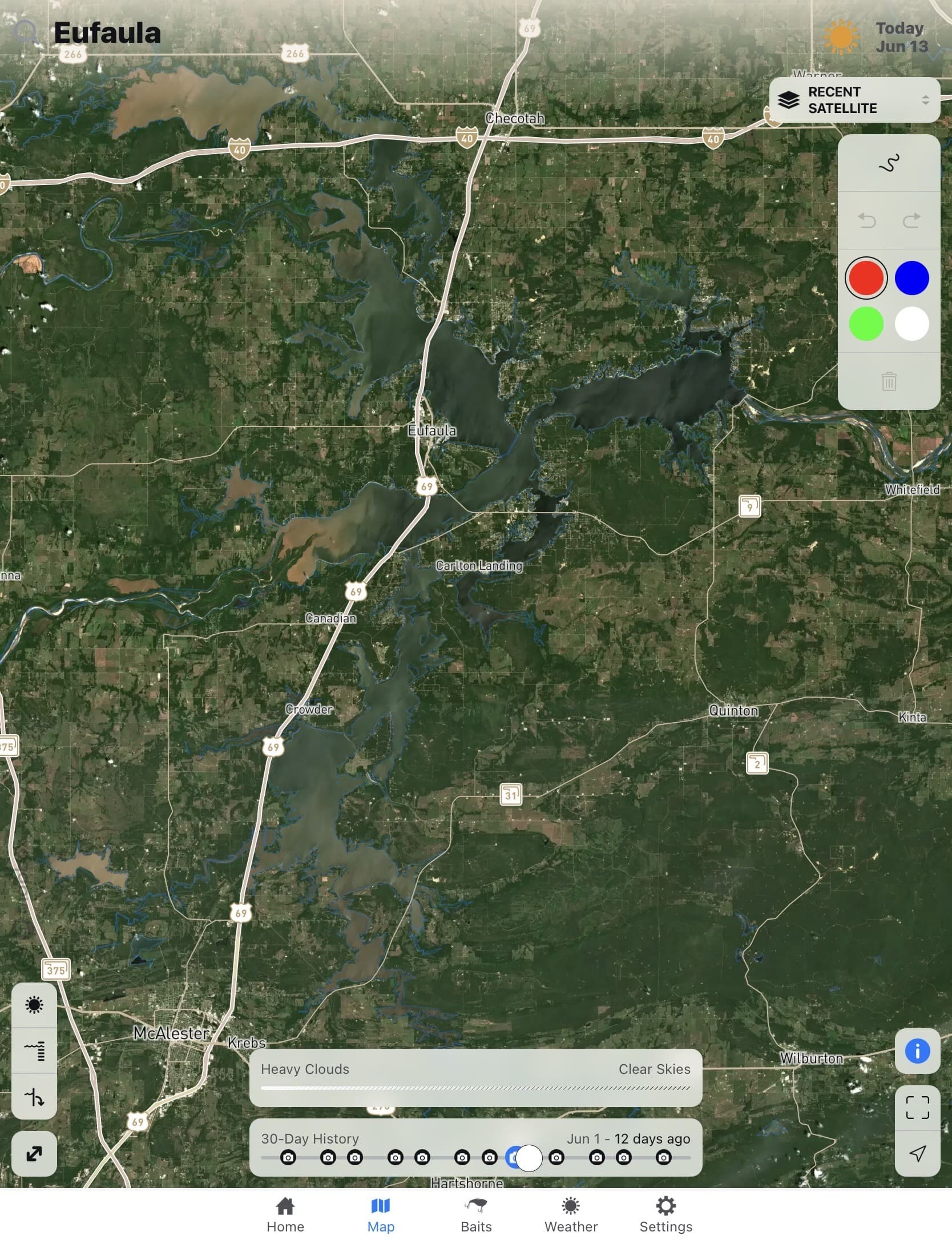
What Tackle Warehouse competitors found in June was a completely different Lake Eufaula than many pros had ever seen before. Instead of a swollen, muddy, rolling reservoir, they found a much lower and clearer lake. On the first day of official practice, Deep Dive’s Recent Satellite feature released a view of Eufaula that showed just how clear the lake had become due to drought. The image was quite stunning. Eufaula looked more like Grand Lake in the summer rather than the usual muddy Eufaula found on Google Earth’s historical images.
The lake’s water level was about normal pool, revealing bare banks with much less cover in the water than in previous events. Water clarity in the lower end of the lake, like Porum, Brooken and The Narrows, retained nearly four feet of visibility. Clear water extended to the north, all the way to the Interstate 40 bridge. The backends of tributaries, especially to the south, offered a rare window of clean, fishable water compared to the usual zero-viz, muddy-water inflow.
High-Tech vs. Shallow-Water Showdown
Pros with a penchant for forward-facing sonar were eager to ply the “new” clear areas of the lake with the beam. They wanted to see just how deep Eufaula bass would go in the summer with increased visibility. At the same time, the bank beaters wanted to explore the shallow ends of the lake during a rare opportunity of such stable water. The event set up perfectly for a super scopers versus bank beaters showdown.
In the scoping corner were proven pingers Drew Gill, Banks Shaw, and the Nutt brothers. In the shallow slammers’ corner, Cal Lane and Drew Boggs donned the big sticks.
On day one of the tournament, Cal Lane took the early lead in the shallows with 22-02, but Carter Nutt and Drew Gill were lurking in third and fifth, respectively.
Will Rainfall Impact Lake Eufaula Water Conditions Overnight?
The wrinkle in the competition came on day two with rain and thunderstorms. The fish still bit for both camps. After day two, Cal Lane resumed the lead, and Drew Boggs took over second place. Both anglers were fishing far south in the Gaines Creek area, targeting ultra-shallow bushes with swim jigs, frogs, and creature baits. But how would day two’s rain affect those shallow, fragile creek ends on the final day of the tournament?
It was a difficult call because the rain was not a day-long deluge. Instead, the rain came from splotchy thunderstorms over central Oklahoma. Could that much rain blow out Gaines Creek, rendering it unfishable on the final day three? How much of that random rainfall would shed into Gaines Creek? How long would it take to reach Lake Eufaula?
Overnight, both Lane and Boggs stressed over these questions, wondering if their primary areas would turn to zero-viz mud. There was no way to know exactly how much runoff the creek would receive overnight before the last day. Or was there?
One look at Deep Dive’s Stream Flow graphic of the Gaines Creek confluence predicted that water would indeed rise significantly on the last day of the event, but most of the rise would occur in the afternoon and into the night. This indicated that the full blowout would not happen in the morning hours.
On the final morning, both Lane and Boggs ran to Gaines Creek, hoping their water would not look like a plowed field. What they found was a pleasant surprise: the water had not turned to chocolate milk. The water had come up a little bit, and there was more visible current, but the water color itself was still very much fishable.
Streamflow Predicts Fishable Water Conditions
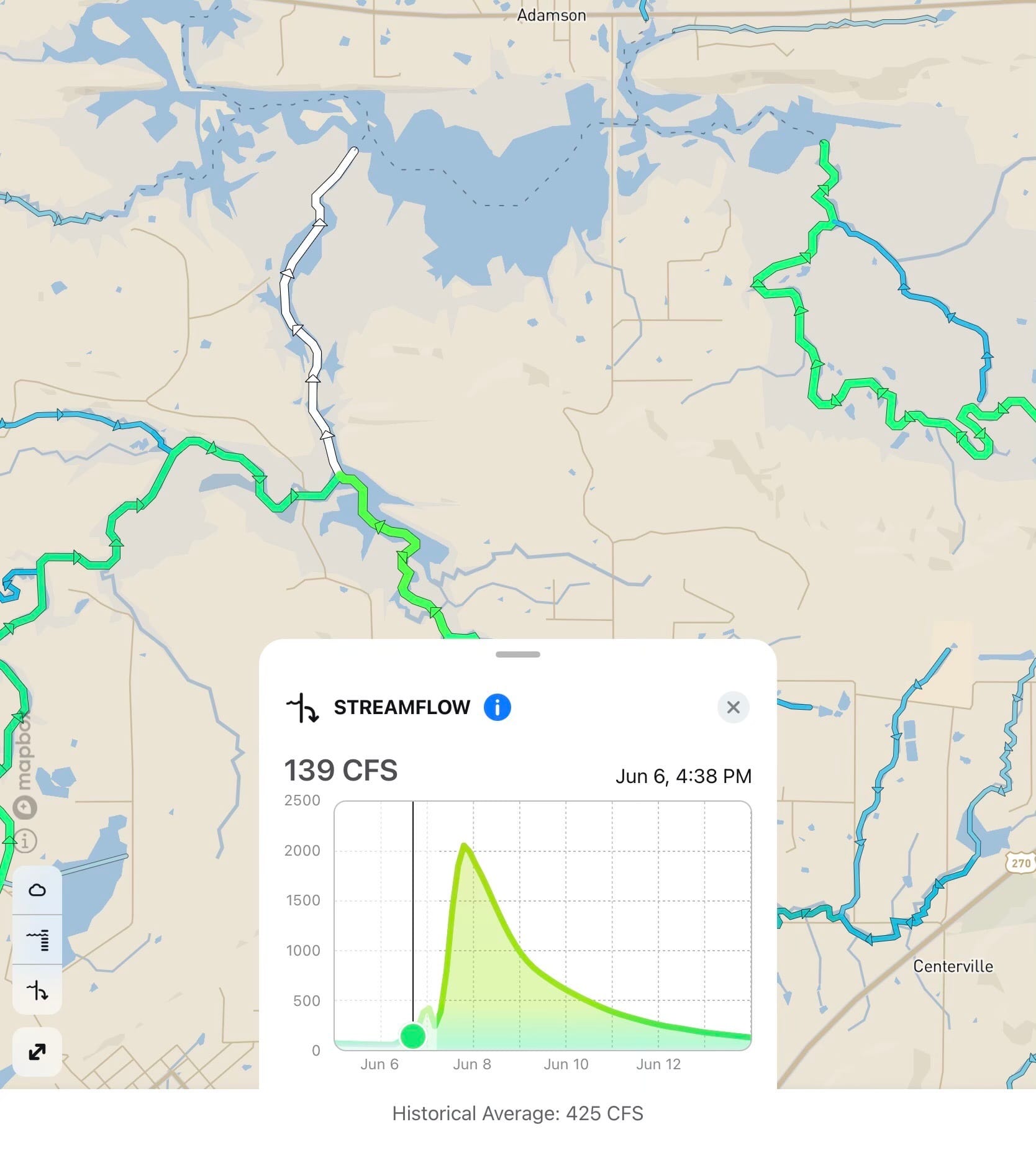
As it turned out, the Stream Flow tool was spot on. Gaines Creek did rise a little bit and flowed a little harder, but it did not completely blow out overnight. In fact, the creek remained fishable for about four to five hours of the tournament day before the water color really began to collapse.
Both Lane and Boggs began catching fish immediately in Gaines Creek, giving them hope that the day would not be a complete washout. With that, the battle between pingers and flingers continued down to the very last minute, making it a great tournament.
In the end, both camps enjoyed the opportunity to fish “new” regions of Lake Eufaula that are usually not as fishable due to muddy water. The scopers prevailed by pinging down to depths of 13 to 18 feet with better water clarity and stability. Banks Shaw took home the win, and Dylan Nutt made a huge stride up the leader board on the final day to finish runner-up. The shallow-water hounds, Lane and Boggs, ended up third and fourth, respectively.
Lake Eufaula was a great reminder that lakes are always changing, and the best way to keep up with those changes is with the Deep Dive app.