Zaldain employs ‘big-little-fish strategy’ for a strong finish at Lake Martin

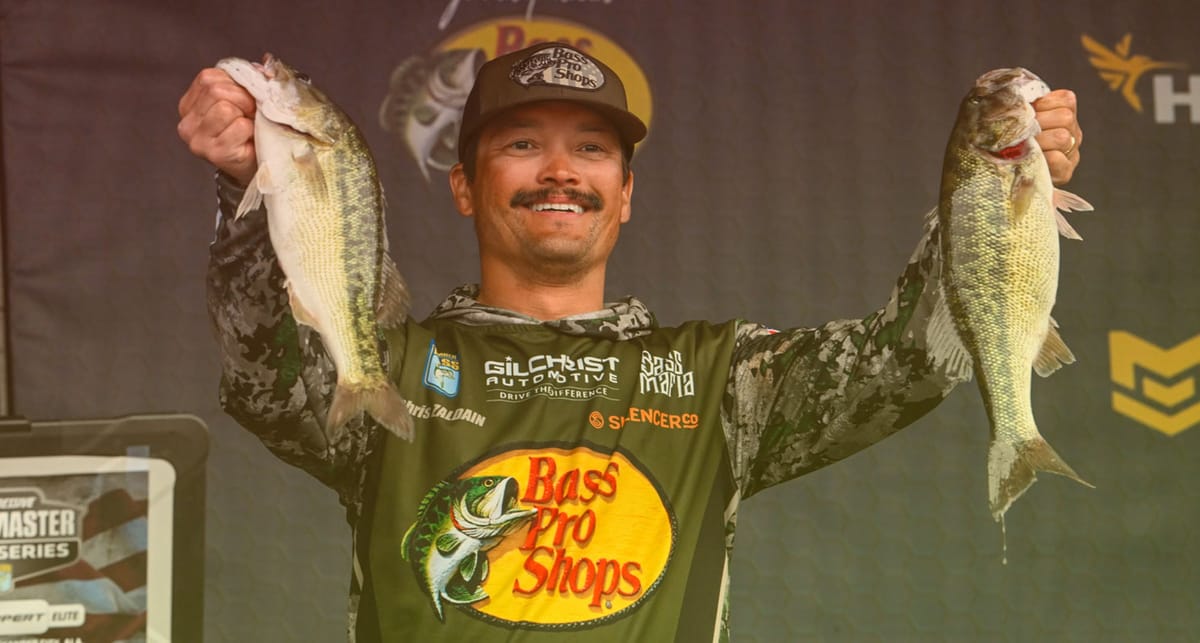
Chris Zaldain caught what he calls “big-little fish” to claim a 6th-place finish at the Bassmaster Elite Series event on Lake Martin in mid-February. While “big-little fish” sounds like an oxymoron, it’s actually an interesting mindset for dealing with lakes that are known for having a big population of small fish.
Zaldain had fished Lake Martin before and was familiar with its characteristics: a deep, clear lake full of spotted bass, with largemouth bass mixed in. While Martin does produce occasional 4- to 5-pound largemouth, it is not considered to be a big fish lake.
“Martin is a large, branchy lake with a lot of tributaries, creek arms and pockets,” Zaldain describes. “It reminds me of the clear-water impoundments of Shasta and Oroville that I grew up fishing in California. They are mixed species lakes, too, with both spotted bass and largemouth.”
Those experiences, along with 15 years of Bassmaster Elite Series competition, have helped Zaldain hone what he calls the “big-little-fish strategy.”
What Is the “Big-Little-Fish Strategy”?
“My goal with these types of lakes is to catch the bigger little fish,” Zaldain says. “Basically, beat the average limit every day of the event. If each of my bass is 6 to 12 ounces better than the average keeper per day, that translates to a 2- to 3-pound heavier catch each day. I know if I can maintain that big-little-fish pace, I’ll move up the leaderboard every day.”
Examining his scorecard for the event, Zaldain did just that. Over the four days, he posted daily weights of 10-0, 11-14, 13-0, and 12-0, respectively, and climbed his way from 54th to 27th to 10th to 6th with a four-day total of 46-14. So how does one go about catching big-little fish?
The standard tournament strategy for Martin is to catch a limit of spotted bass first and then target largemouth for upgrades. Instead of starting in clear-water, spotted bass areas to catch a limit, Zaldain commits exclusively to largemouth water all day, where he believes the bigger-little bass are more prevalent.
“The primary ingredient for this strategy is staying in the areas where the water has the most color,” he explains. “As long as it’s not fresh mud, heavily stained water tends to be the warmest, most fertile, and contains the most forage.”
Using Water Clarity Maps to Find Warm Water
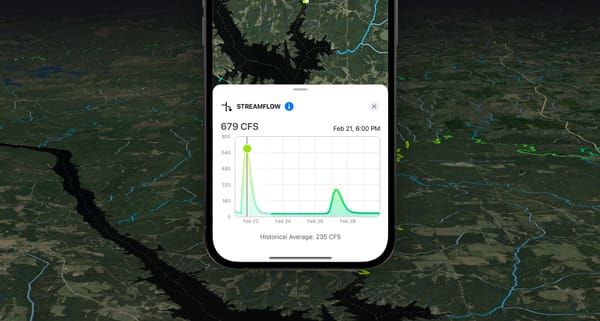
To find these places, Zaldain uses the Deep Dive Water Clarity map. During practice at Martin, he explored six or seven areas that held the most color. As expected, they were also warmer.
“The main lake body was about 48 degrees,” he details. “When I ran to the places that had the most water color on Deep Dive, it was 50 to 53. That 4- to 5-degree temperature change is huge in terms of finding the big-little fish in February.”
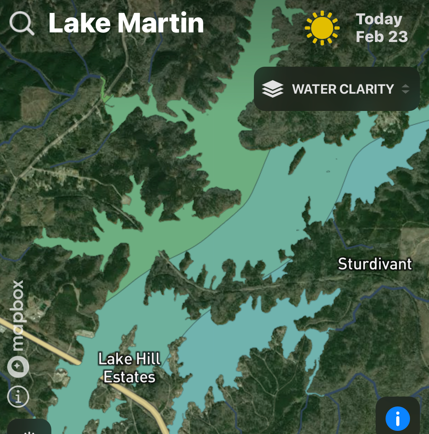
To see how Deep Dive can help you find the warmest water in the lake, check out this blog post.
After sampling a half-dozen areas with the heaviest-stained water, Zaldain eventually settled on Wind Creek to start the tournament. Wind Creek had the warmest water, the best cover, and is always replenished with bass since many of Lake Martin’s tournaments launch from there.
“The lake was 7 feet low,” he says. “I could read a lot of the banks and shallow cover the fish were using. I found warm, dingy water in other creeks, but they were just too flat and coverless to hold numbers of fish.”
Specifically, Wind Creek held the exact combination of cover Zaldain was looking for: steeper, rocky banks sweetened with laydowns.
“It was the kind of largemouth water that also held a few spotted bass,” he adds. “I could commit to largemouth all day, catch two or three of those, and incidentally catch some solid spots as well, making for a great mixed bag.”
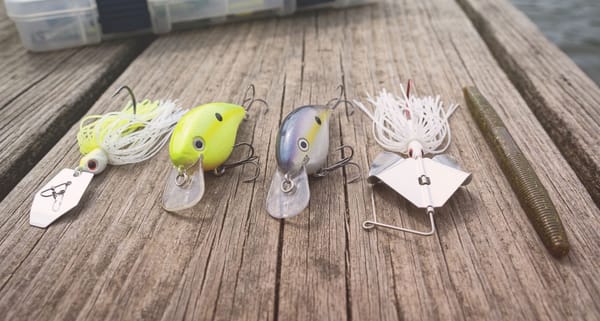
The second component of his strategy was to throw a bigger bait: a Bass Mafia 5-inch Daingerous swimbait rigged on a 3/16-ounce inline jighead. Finally, some clouds and wind were also needed to make the big-little fish more cooperative
“The only thing that bothered me was that the first two days of the tournament were forecast to be sunny and flat calm,” he details. “But the last two days were calling for clouds, wind, and rain. I figured if I could just grind my way into the top 50 and make the third day to take advantage of the incoming weather, the swimbait would play big time.”
The clear, bright weather on the first two days forced Zaldain to “worm around” with Neko rigs. After making the day-three cut, he was finally able to unleash the swimmer and go to work.
Analyzing Wind Patterns with Wave Impacts
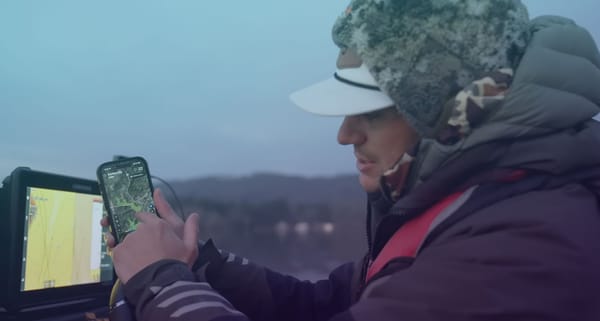
“We finally got the clouds and breeze,” he recalls. “I pulled up the Deep Dive app and studied the Wave Impacts map to see which banks were receiving the best wind on the lay downs. Having that breeze on the laydowns was crucial in making the whole pattern work.”
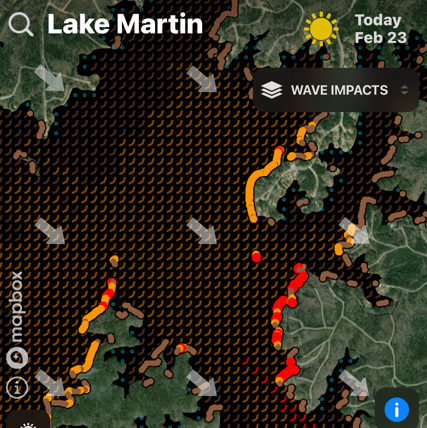
Another critical aspect of the pattern was to use unique casting angles.
“I wanted to make presentations that were different from the norm,” he explains. “I wanted to make presentations that were with the wind, even if that meant positioning my boat up on the bank and throwing out to the deep part of the laydown and reeling the swimbait ‘uphill’ along the trunk. If the wind was blowing across the tree, I would line my cast up to cross the tree with the wind.”
The Lake Martin Elite Series was a scoping event, which allowed Zaldain to “beam the laydowns” before approaching them.
“Where the fish were set up on the tree played into my casting angles as well,” he says. “I wanted to make sure the bait rolled right over that sweet spot on the trunk.”
When it all came together, Zaldain could call his shots on certain laydowns.
“The perfect scenario was a group of fish set up in the bushiest part of a laydown about mid trunk, with the wind blowing across it,” he offers. “I would scope around to find the perfect casting lane across the tree. I took the time to position the boat correctly to make a perfect cast and roll the swimmer over the fish, and they would smash it.”
Zaldain weighed in his best two limits of the event on days three and four.
“It’s so gratifying to get a pattern dialed in like that and move up in the standings every day,” Zaldain adds. “I might not have caught the biggest fish in the tournament, but I caught the big-little fish every day.”