Five Baits for January

Two thousand twenty-six has arrived. It’s time to go fishing in the new year, but the pond is cold!
Really cold.
Maybe even solid cold.
There is no denying it, January is straight up winter across much of the country. For the next month, most bass anglers will be facing water temperatures that range from 55 degrees all the way down to hard water. During this time, the overall metabolic rate of a lake slows down as a whole. Other than loons, underwater life seems to be in a hibernative state.
Not only is the water cold, but it’s also usually low and clear due to winter drawdowns. Given that, winter bass tend to favor places where they can move up and down in the water column over points, along bluffier banks, in standing timber, or around dock supports and cables. This time of year, they will also get tight to the bottom, hugging rocks or stumps.
With these ideas in mind, January is definitely the most “vertical” month of the year. If you are facing 40-degree water temperatures this month, vertical presentations are historically a good frigid-water solution.
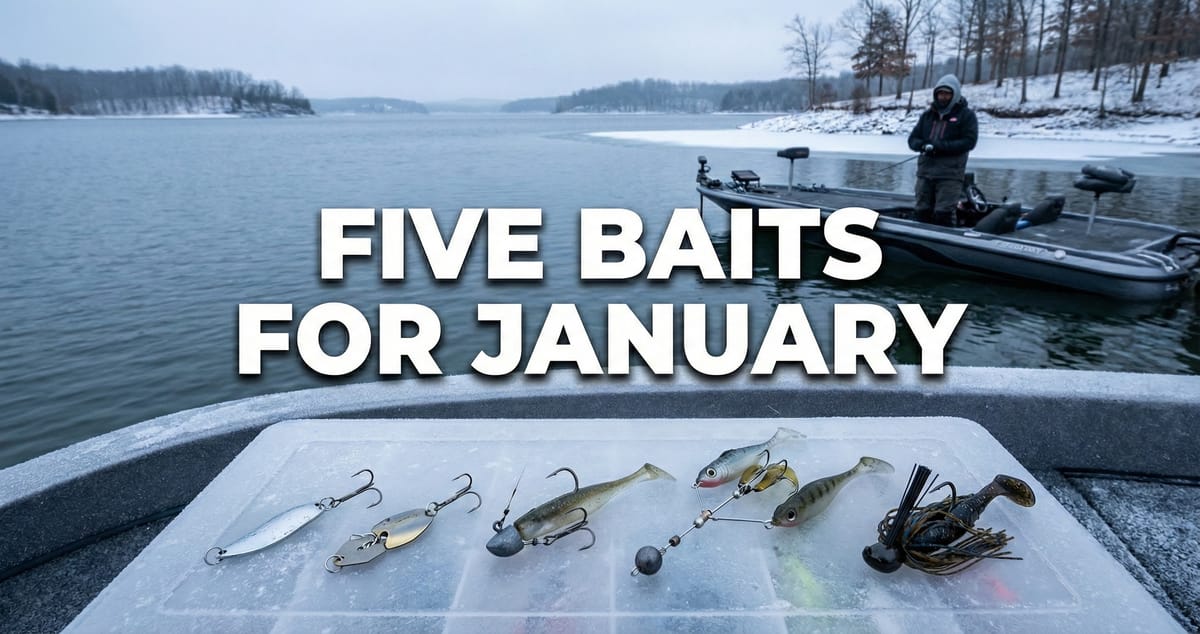
One of the best ways to get directly vertical when targeting bass is with metal baits, such as jigging spoons and blade baits. If you are new to bass fishing, you might think that jigging a slab of metal for bass is a waste of time. Indeed, these are very niche baits, but when the metal-bait window opens, it’s mind-boggling how well they work.
Jigging spoons such as Hopkins’ NO EQL, Nichols’ Duh spoon, and Sixth Sense Divine series spoons are all great for vertical jigging depths from 20 to 60 feet under the boat. Use them to target shad balls or jig them right off the bottom when bass are tight to the floor. It’s surprising how many bass will snap up spoons jigged right on the bottom.
If you prefer a casting version of a bladed bait, consider Jackall’s Keeburn, Damiki’s Vault, Rapala’s Rippin’ Blade, Sixth Sense’s Slice Blade, Deps’ Circuit Vibe Blade, or the classic Heddon Sonar – to name a few. These are sneaky baits when bass are glued to the bottom in the cold. Use a pump-and-drop retrieve to create their unique bait signature. Pull the bait up off the bottom to engage a tight vibration. Then drop it back down on controlled slack to produce a shimmying, dying shad look.
Winter time is also a lethal time for minnow shaking, which to a degree, is still a vertical form of fishing. Whether it’s called shaking, strolling, hover-rigging, or moping, it’s all born from the same concept as Damiki rigging, which has been done vertically on 2D for over a decade. Back in the 1980’s this same technique was called “doodling,” basically shaking a 4-inch finesse worm over bass with a flasher. No matter what it’s called, wiggling a soft plastic lure vertically over a bass in cold water has long been a winter-time staple in bass fishing.
Over the last 5 years, forward-facing sonar dovetailed with Damiki rigging, creating a castable technique used to shake a minnow over depth at a distance to tease fish into biting. This has given rise to an explosion of soft plastic minnows of various shapes and sizes, as well as a myriad of jig heads to pair with them.
If jigging and shaking is not your jam and you prefer hurling something way out and reeling it in, then an umbrella rig is a fit for January. The umbrella rig, or Alabama rig, has always burned the brightest in the depths of winter. Since bass are usually keyed in on deep shad pods this time of year, it’s hard to go wrong with a lure – or harness – that resembles an entire bait ball.
Umbrella rigs require some extra effort, though, starting with knowing the state laws on how many hooks can be used on a single line. Also, some tournament trails have limitations on umbrellas, so be mindful of the rules. Umbrella rigs can be awkward to store and carry, too. They require a lot of TLC when rigging to keep all the baits straight. Regular tangling and snagging are part of the program as well. However, when it comes to covering miles of open water quickly, nothing beats the drawing power of an umbrella rig.
In terms of brands, there are literally 30 lure brands that make umbrella rigs. No matter if you want swim teasers, or blades, or multiple harnesses hooked together, every variety imaginable is available.
If all else fails in the frigid waters of January, slow dragging a heavy jig on the bottom still turns up some impressive catches. One of the last ways bass can hide from beam detection these days is to hunker down in divots and potholes. The best way to probe these nooks and crannies is to keep a football jig in constant contact with the bottom. Half-ounce jigs will work in water less than 10 feet deep. But if you’re looking to furrow the floor in the 10- to 30-foot range, better go to a ¾-ounce. As for trailers, keep the action straightforward and subtle, without the aggressive flapping action.
The secret to dragging a jig in winter is to go S-L-O-W. The best jig draggers want to feel every pebble and twig. Most importantly, they want the jig to drop into every tiny micro-contour in the bottom. Dragging a jig may not seem like a “reaction” technique, but when the jig suddenly drops into a bass’ studio-sized pothole, the impulse to attack is reflexive. For whatever reason, purples and browns – or a combination of those colors – are excellent football jig colors in winter.